








Asia's technology giants set to become leading players in their fields and real estate markets around the world.
Asia’s homegrown technology giants have transformed the way the region lives, works, and plays, and our research shows they are poised to have a similarly outsized impact on property markets.
Data we recently shared at a CoreNet Global event illustrates that we are in the early stages of a significant shift. Leasing demand in the tech sector in Asia, as elsewhere, has traditionally been dominated by global groups like Google, Amazon, Microsoft, and Facebook. But with Chinese firms leading the charge, Asia’s tech players are becoming major market forces – set to stoke competition for prime real estate and contribute to the exciting investment opportunities emerging in the region.
Several factors are supporting this transition. One is demographics. In many regional economies, the ranks of Internet users and the middle class are expanding rapidly, and still have plenty of room to grow. The surging growth of e-commerce is another contributor. Asia Pacific already accounts for the bulk of global e-commerce revenues, which are set to nearly double to US$2.5 trillion by 2025.
"With Chinese firms leading the charge [of leasing demand], Asia’s tech players are becoming major market forces – set to stoke competition for prime real estate and contribute to the exciting investment opportunities emerging in the region."
Finally, uptake of ‘super-apps’ that group services from digital payments to transport and food delivery, like China’s Alipay as well as Grab and Gojek in Southeast Asia, has been massive, and these companies are poised to expand their offerings and customer bases even further.
Given Asia’s leading tech firms are posting faster growth trajectories than Western peers at similar stages of development, we expect these trends to continue and to fuel a rush of activity in preferred destinations for tech occupiers as they explore new markets.
Chinese tech groups, for example, currently occupy 10% of prime office stock in key domestic markets, and by our estimate will account for up to 18% of demand for Grade A office leasing demand in the region between 2020-2025 – a period over which we expect cumulative aggregate demand for Grade A office space to be just over 26 million sq m.
All told, Asian tech firms could represent up to a quarter of leasing demand in this timeframe. This means they will become major drivers of rents, leasing structures, and even the incentives and amenities offered by asset owners.
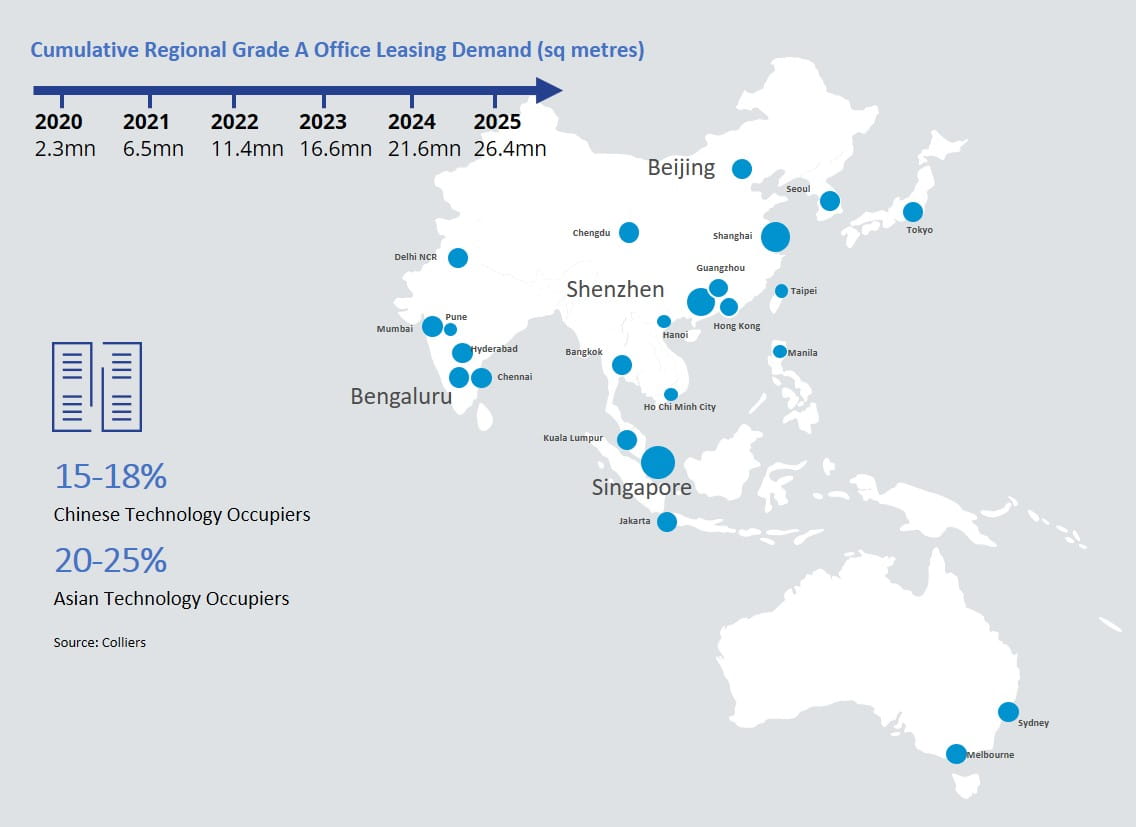
Cumulative regional Grade A office leasing demand in Asia Pacific (source: Colliers)
We have already seen tech occupiers cluster around industry hubs identified in our Tech Jewels research of May 2019, such as Bangalore’s Outer Ring Road, Shenzhen’s Hi Tech Park and Shenton Way/Tanjong Pagar in Singapore.
As tech firms expand, these clusters will become even more sought after, with occupiers vying for prime assets and focusing on properties that offer the right balance of accessibility, infrastructure, and workplace experience. Their vibrancy should see these tech-heavy sub-markets play a larger role in regional investment strategies. We will explore the topic of tech submarkets and their characteristics in greater detail in a new report in Q2 2021.
Fintech, and what comes next
Within the overall tech market, we believe the fintech sector deserves particular attention due to its growth prospects and potential to disrupt the main occupier of Grade A office space in the region – financial services.
In Southeast Asia in particular, the fintech opportunity is unparalleled. Southeast Asian countries have a combined Internet user base of over 600 million, many concentrated in urban areas; rising demand for and adoption of digital financial services; and a significant proportion of the population that is still unbanked. This points to a major gap that the region’s fintech enterprises (“fintechs”) can move to fill.
"Asian tech occupiers will continue their expansion – not just in terms of revenues, headcounts and square footage, but also the grade of commercial assets they will be seeking."
Investors have taken notice. Despite receiving less investment overall than online retail and mobility players over the past few years, the fintech sector is home to the vast majority of Southeast Asia’s venture capital-backed startups.

Why fintech matters: The fintech sector is home to the vast majority of venture capital-backed startups in Southeast Asia (source: The future of fintech in Southeast Asia)
Given regulators across the region are moving to nurture fintechs by issuing licences and creating sandboxes (i.e. testing environments) where they can trial products and services, we anticipate substantial headcount growth and therefore commercial space needs from fintechs. In Singapore, we estimate fintechs could account for up to 500,000 sq ft (46,500 sq m) of new office space demand by 2025.
With the rollout of 5G, the emphasis governments are placing on grooming next-generation industries, and the region’s history of ‘leapfrogging’ stages of development in industries like finance and healthcare, we are confident that Asian tech occupiers will continue their expansion, not just in terms of revenues, headcounts and square footage, but also the grade of commercial assets they will be seeking.
Asset owners and investors should watch this space closely, particularly as leading Asian firms are increasingly international in their ambitions. We can easily envisage a time when Asia’s tech hubs will be centres for global as well as regional innovation, when Asian tech giants are no longer just ‘Asian,’ but leading players in their fields and real estate markets around the world.
For more insights on how work ‘place’, ‘space’ and ‘pace’ are evolving in the technology sector and the opportunities they are presenting for tech occupiers going forward, read the latest edition of The Reimagined Workplace Q&A | Technology.
---
Article enquiries
Contact us here.